
Portfolio Management
When Political Winds Change, Should Your Portfolio?
“What separates the winners from the losers
is how a person reacts to each new twist of fate.”
~ Donald Trump
We’re a year into President Trump 2.0…
And, so far, a blitzkrieg approach to lawmaking that makes his first term look tame.
Within hours of taking office, the president signed more than 200 executive actions, including rescinding nearly 80 actions under President Joe Biden.
In a recent Money & Power issue, Buck Sexton praises Trump’s logic.
“[The] government wasn’t working… Costs kept rising, institutions kept growing and somehow nobody was ever responsible for any of it,” Sexton writes. “Trump looked at that system and treated it the way a CEO treats a failing business. Move first. Apply pressure. Force decisions. Argue about permissions later.”
This pressure-first style works, Sexton argues, because it forces institutions, markets, and opponents to react immediately – often shifting leverage before the policy details are even settled.
For regular investors trying to grow and protect their nest egg, Trump’s approach raises a practical question:
When political winds change on a dime – should your portfolio?
John Parise of Copper Beech Financial Group says absolutely not – if you’re doing it right…
“Politics only affects the short term, and you don’t really have to play that game if you don’t want to,” he emphasized.
Parise has worked with families for over 40 years to help create and protect multi-generational wealth. His team’s work spans tax strategy, estate structures, asset protection, and family governance – the structural foundation behind long-term wealth.
In his planning framework, what tends to matter more is whether the portfolio has a clearly defined long-term strategy, intentional asset roles, and a strong focus on tax efficiency. When those elements are in place, Parise says policy cycles become background noise – not a trigger for constant change.
Historical market data tends to support that long-horizon view…
In the table below are key U.S. equity index returns during each presidential term from 1900–2025:
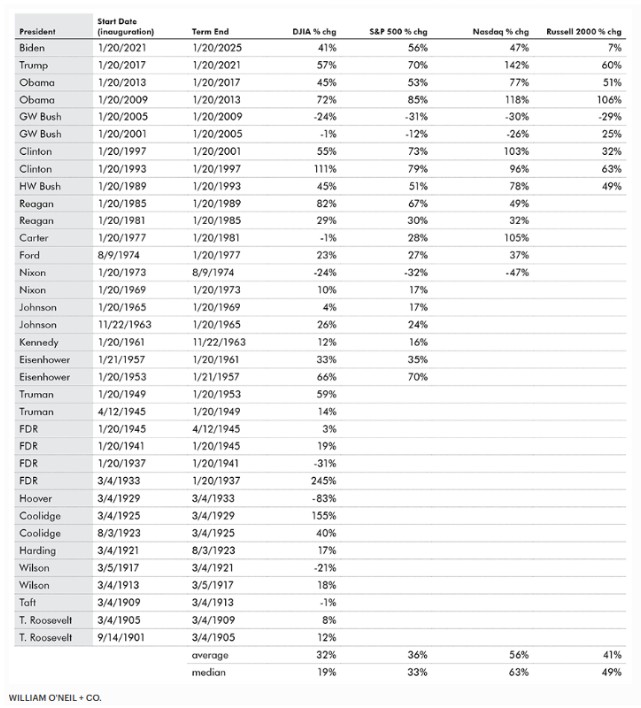
You’ll note the median return for the S&P 500 over a four-year presidential term is 33%.
And that only two presidents, George W. Bush and Richard Nixon, posted returns of less than 10%.
This supports Parise’s point:
Historically, the time horizon has often mattered more than timing reactions to political changes.
Instead of asking how to react to each political shift, Parise encourages clients to pressure-test the structure underneath their plan.
Key questions he often walks families through include:
- Is the portfolio built around a multi-decade time horizon… or short-term expectations?
- Does each asset class have a defined role – growth, income, stability, or tax advantage?
- How exposed is the plan to unnecessary tax drag?
- Are inflation and purchasing-power risks addressed through growth assets?
- Are estate and transfer structures aligned with long-term family goals?
Once a nest egg is set up to be politics-proof per this framework, Parise notes you can certainly have fun spotting investment opportunities as they arise.
P.S. For readers who want to continue exploring long-term planning to “risk proof” their portfolios, WorthNet helps connect investors with pre-vetted independent firms, including Copper Beech Financial Group and John Parise. Simply click the button below to get started.
WorthNet itself doesn’t provide advisory services and is not a client of Copper Beech Financial Group or the other advisers; rather, we are compensated for promoting certain advisers in our network and we have a financial incentive to recommend these advisers, which creates a material conflict of interest.
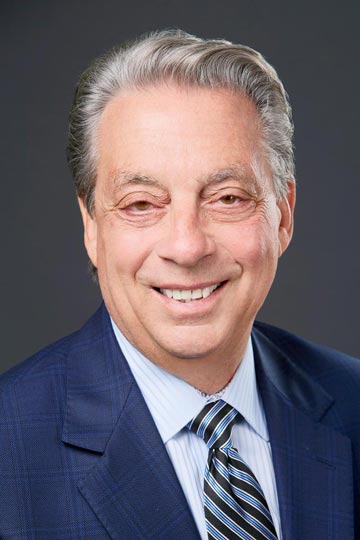
John J. Parise
Founder & Managing Partner of Copper Beech Financial Group
Your Generational Wealth Partner
John J. Parise is a seasoned investment adviser who has helped families optimize their investments for taxes and developed cross-generational plans to preserve wealth for nearly 40 years. His firm, Copper Beech Financial Group (CRD #313156), is a proud member of the WorthNet partner adviser network.
Ready to Connect with a Financial Adviser?
Let’s Get Started.
Last Revised: March 4, 2026
Copper Beech Disclosures: Securities offered through Osaic Wealth, Inc., member FINRA/SIPC. Investment advisory services offered through Copper Beech Financial Group, LLC, an SEC-registered investment adviser. Additional advisory services may be offered through Copper Beech Financial Group. Osaic Wealth is separately owned, and other entities and/or marketing names, products, or services referenced here are independent of Osaic Wealth. Copper Beech is not affiliated with Osaic Wealth, Inc. Neither Osaic Wealth, Inc., nor its representatives provide tax, legal, or accounting advice. Please consult your own tax, legal, or accounting professional before making any decisions. These opinions are subject to change at any time without notice. Any comments or postings are provided for informational purposes only and do not constitute an offer or a recommendation to buy or sell securities or other financial instruments.